Generative Engine Optimization (GEO) is becoming an important topic in digital marketing as people increasingly use AI-powered search experiences to find information, compare products, research businesses, and answer questions. Instead of only looking through traditional search results, users can now receive summarized answers through AI-powered search experiences.
For website owners, bloggers, freelancers, and businesses, this creates a new opportunity: making useful content easier for search systems and AI-powered experiences to discover, understand, and reference.
In this guide, you will learn what Generative Engine Optimization means, how GEO differs from traditional SEO, why AI search matters in 2026, and practical ways to make your website more useful and discoverable.
What Is Generative Engine Optimization?
Generative Engine Optimization (GEO) refers to practices intended to improve how a website, brand, or piece of content is discovered, understood, and potentially referenced in AI-generated search experiences.
These experiences can include systems such as Google AI Overviews, AI Mode, ChatGPT, Gemini, and other AI-powered search products.
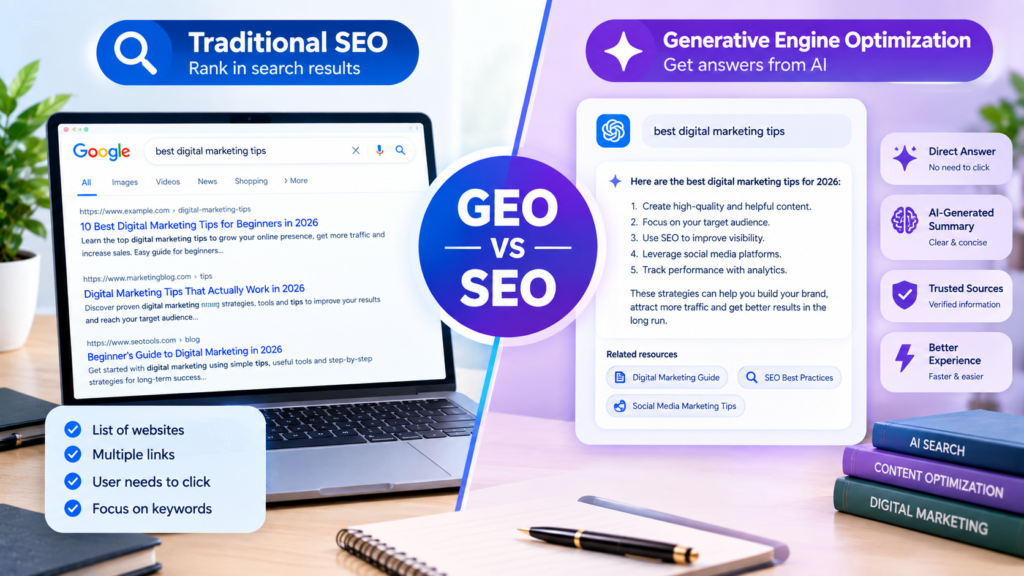
Traditional SEO mainly focuses on helping pages appear prominently in search results. GEO focuses on the wider experience in which AI systems retrieve information and generate an answer for the user.
However, GEO and SEO work together, so GEO cannot replace SEO completely. Google states that its generative AI search features are built on its existing Search systems, meaning fundamental SEO practices continue to matter.
Why Is GEO Important in 2026?
Search behavior is changing quickly. Users can ask longer and more conversational questions and receive summarized information instead of manually opening many websites.
Current SEO research also shows growing interest in the GEO and AI-search keyword cluster. Ahrefs reports that searches for terms such as “generative engine optimization” and “GEO vs SEO” have increased substantially.
This means website owners should understand how their existing SEO strategy fits into the changing search environment.
The opportunity is not simply to add the word “AI” to every article. The real goal is to create useful, trustworthy, well-organized information that can satisfy a user’s question.
GEO vs SEO: What Is the Difference?
SEO and GEO are closely connected, but they describe different aspects of modern search visibility.
SEO (Search Engine Optimization) focuses on improving a website’s ability to appear in traditional search results.
GEO (Generative Engine Optimization) is commonly used to describe efforts to improve the chance that content or information is surfaced or referenced within AI-generated answers.
For example, traditional SEO often focuses on searches like:
“best freelancing skills for beginners”
A GEO-focused approach also considers conversational questions such as:
“What freelancing skill should a beginner learn in 2026?”
Good SEO practices are still the foundation of a successful online presence.Google specifically says there are no special technical requirements or special markup required to appear in AI Overviews or AI Mode.
How Does Generative Engine Optimization Work?
AI search experiences can use information retrieved from online sources to create an answer. Google describes techniques such as retrieval-augmented generation and query fan-out as part of how its generative search experiences can retrieve information from multiple related searches and sources.
This makes several areas important for website owners:
1. Create Clear and Useful Content
Answer the main question clearly and avoid lengthy introductions that may waste the reader’s time.
Start with a clear explanation, then provide supporting details, examples, steps, and practical information.
2. Use Clear Headings
Use clear and meaningful H2 and H3 headings to structure your article and make it easier to read.
For example:
- What Is Generative Engine Optimization?
- GEO vs SEO
- Why GEO Matters
- How to Optimize Content for AI Search
This makes the article easier for people to read and helps search systems understand its structure.
3. Answer Specific Questions
Instead of writing only broad statements, answer real questions your readers may have.
For example:
Can GEO replace SEO?
No. GEO does not replace traditional SEO. Google states that its generative AI search features continue to rely on core Search ranking and quality systems.
Short, direct answers followed by useful explanations can make an article easier to understand.
4. Add Original Value
Simply rewriting information that already exists on hundreds of websites is unlikely to make your article stand out.
Google recommends creating helpful, reliable, people-first content with value beyond ordinary or commodity information.
You can add value through:
- Original examples
- Practical steps
- Personal experience
- Screenshots where appropriate
- Original comparisons
- Case studies
- Updated information
- Clearly explained mistakes to avoid
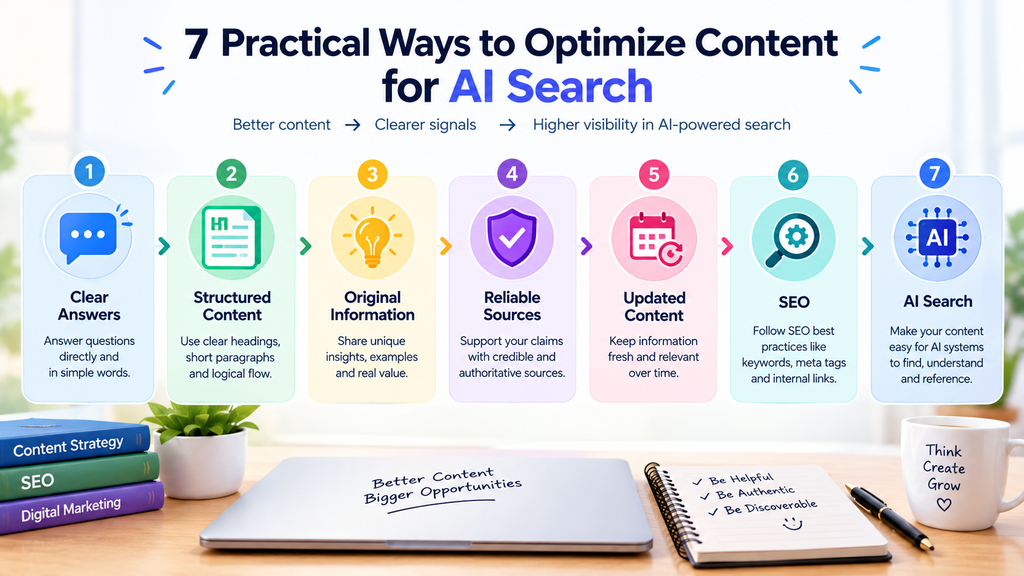
7 Practical Ways to Optimize Content for AI Search
1. Write for People First
Avoid creating content just for the sake of adding keywords.
Your first priority should be answering the reader’s question clearly and completely.
Google’s current guidance emphasizes helpful, reliable, people-first content rather than content created primarily to manipulate search systems.
2. Put the Main Answer Near the Beginning
Readers should understand the basic answer quickly.
For example, if your article explains GEO, define it within the opening section before moving into technical details.
This also gives readers a reason to continue reading.
3. Build Topic Depth
Instead of publishing many thin articles targeting slightly different keywords, create useful topic coverage.
For a website about online earning and digital skills, a GEO content cluster could include:
- Generative Engine Optimization
- GEO vs SEO
- AI search optimization
- Google AI Overviews
- AI visibility
- SEO for beginners
- Content optimization
- Search Console
You can link these related articles together using internal links.
4. Use Reliable Sources
When discussing statistics, Google updates, SEO changes, or technical information, link to trustworthy sources.
Google’s official Search documentation should be preferred for claims about Google Search itself.
5. Keep Important Information in Text
Do not put your entire explanation inside an image.
Google recommends making important content available in textual form and maintaining good technical accessibility.
Images can support your explanation, but they should not replace the main written content.
6. Improve Internal Linking
Connect related articles naturally.
For example, an article about GEO could link to your existing article about SEO or digital skills.
Internal links help readers discover related information and help search engines understand relationships between pages.
7. Keep Content Updated
AI search and SEO are changing quickly.
If an article contains outdated information, update important sections instead of allowing old claims to remain indefinitely.
Google’s own documentation around AI Search continues to be updated, including guidance on AI Overviews, AI Mode, and generative AI optimization.
Does GEO Replace Traditional SEO?
No.
This is one of the biggest misunderstandings surrounding Generative Engine Optimization.
Google’s official guidance says that SEO remains relevant because its generative AI features are rooted in Google’s core Search ranking and quality systems.
Therefore, website owners should not abandon:
- Technical SEO
- Helpful content
- Internal linking
- Crawlability
- Mobile-friendly design
- Good page experience
- Clear website structure
- High-quality sources
- Relevant images
Instead, GEO can be viewed as part of the broader evolution of search visibility.
Common GEO Mistakes to Avoid
Keyword Stuffing
Repeating “Generative Engine Optimization” dozens of times will not automatically improve visibility.
Use the keyword naturally.
Creating Multiple Similar Articles
Publishing separate pages for every tiny variation of the same question can create repetitive content.
Google specifically warns against creating large numbers of pages primarily to manipulate rankings or generative AI responses.
Believing in Special GEO Hacks
Some websites claim that special files, secret prompts, or unusual markup can guarantee AI citations.
Google says there are no special technical requirements or special schema needed to appear in AI Overviews or AI Mode. It also states that llms.txt is not required for Google Search visibility.
Copying Competitors
Looking at competitors can help identify search intent and missing topics, but copying their structure or wording will not create a strong long-term website.
Your article should add something useful that the reader cannot get from a basic copy of another page.
Can GEO Help a Website Make Money?
GEO itself does not guarantee income.
However, better search visibility can potentially bring more relevant visitors to a website. Those visitors may create earning opportunities through advertising, affiliate marketing, digital products, services, or other legitimate website monetization methods.
For an AdSense website, the priority should therefore be useful traffic rather than simply more traffic.
For example, an article about GEO could attract readers interested in:
- SEO services
- AI marketing tools
- website optimization
- blogging
- digital marketing
- online business
These topics can also create opportunities for related informational articles and relevant affiliate content.
Google notes that visitors arriving through its AI search features can sometimes show stronger engagement, although this should not be interpreted as a guarantee for every website or page.
GEO Checklist for Beginners
Before publishing an article, check the following:
- Is the main topic clear?
- Does the introduction answer the main question?
- Is the focus keyword used naturally?
- Are headings descriptive?
- Does the article provide original value?
- Are important claims supported by reliable sources?
- Are related articles internally linked?
- Is the page mobile-friendly?
- Are images relevant and optimized?
- Is the content easy to scan?
- Is the article written for people rather than only search engines?
- Is outdated information removed or updated?
Final Thoughts
Generative Engine Optimization (GEO) is becoming an important part of the conversation around modern search. AI-powered search experiences are changing how people discover and consume information, but this does not mean traditional SEO is disappearing.
For beginners, the best approach is to build strong SEO foundations and combine them with genuinely useful, well-structured, trustworthy content.
Rather than searching for a secret GEO trick, focus on answering real questions, providing original value, using reliable information, improving your website structure, and keeping important content accessible to search engines.
As AI search continues to develop in 2026, websites that consistently provide useful information will have more opportunities to participate in the changing search landscape and reach people looking for reliable answers.
Frequently Asked Questions (FAQs)
Is GEO the Same as SEO?
GEO and SEO are closely related, but they are not exactly the same. SEO focuses on improving visibility in traditional search results, while GEO focuses more on visibility within AI-generated search experiences. Good SEO practices remain important for generative AI search features.
Does GEO Replace SEO?
No. GEO does not replace traditional SEO. SEO remains an important foundation for making content discoverable, while GEO adds additional considerations for AI-powered search. For more details, see the “Does GEO Replace Traditional SEO?” section above.
How Can I Optimize Content for AI Search?
You can improve your content for AI search by:
- Answering questions clearly and directly.
- Using clear headings and well-organized sections.
- Providing accurate, useful, and original information.
- Supporting important claims with reliable sources.
- Using simple language that AI systems can understand easily.
- Keeping content updated when information changes.
- Following normal SEO and Google Search best practices.
Google’s current guidance also emphasizes that SEO best practices continue to be relevant for visibility in its generative AI search features.
Does GEO Guarantee AI Search Visibility?
No. There is no guaranteed method for making an AI system cite or display a particular webpage. AI search systems use multiple sources and automated processes to determine which information to show.